News
"Can I Control How My Contributions Are Invested?"
"Can I Control How My Contributions Are Invested?"
We receive plenty of questions pertaining to ASRS contributions. Most of these questions center on members' desires to manage how their contributions are invested or wanting to contribute a different amount – whether less or more. Unfortunately, the ASRS is unable to accommodate any of these requests.
Part of being a member of a Defined Benefit Plan, such as the ASRS, means mandatory participation for anyone meeting membership criteria. All members pay the same contribution rate, and everyone's contributions are invested by our internal team of investment professionals. Contributions from all members and employers are pooled together so they can be invested and grown to fund member benefits such as long term disability and retiree pension benefits.
For those wanting to put additional money aside for retirement and desire a plan in which they can decide how funds are managed, there are supplemental savings plans available to all ASRS members. We encourage you to visit our Supplement Your Retirement page, where you'll find an overview of available plans administered by Nationwide Retirement Solutions and overseen by the ASRS.
If you're interested in learning more about how your ASRS plan differs from other types of retirement savings accounts, you can visit our Retirement Plans Comparison page. If you'd like to learn more about ASRS investments, visit our Investments section of the website.
Work in Education? Things Add Up a Little Differently!
Work in Education? Things Add Up a Little Differently!
So, you work for a school as a nine-month teacher or employee. Did you know your ASRS service is calculated differently than your 12-month counterparts in public service? As an educational employee, you earn .111 years of service credit per month instead of the .083 years non-educational employees accrue. That means you are earning a full year of service in nine months.
Before you run off to pick up another ASRS gig during the summer to earn even more service credit, be aware that members cannot earn more than one year of service in a fiscal year (A.R.S. § 38-739), so you actually won’t be able to accrue any additional service during that 2-3 month period where you’re not working at the school.
Speaking of summer break: if you log into your myASRS account on your summer break & it says you’re “inactive,” don’t panic! This is completely normal! If the ASRS has not received contributions for 30 days, our system will default the member’s status to “inactive,” but will automatically return the status to “active” once contributions resume.
What About Teaching Summer School?
While teaching summer school will increase your Average Monthly Compensation (AMC), which may increase your future retirement benefit calculation, it will not increase your years of service calculation. So, while teaching summer school may not allow you to retire any sooner, it could be a way to increase the pension you’ll receive when you retire.
- Curious about your future benefit? Check out “Estimate Your Benefits.”
What If I Switch to Another School?
As long as the school is an ASRS employer, your pension and all your accrued service go with you! Even if you decide to stop teaching, you can continue contributing towards your pension at a different ASRS employer. The ASRS has over 700 employers representing all levels of education, counties, and State service: if you leave one ASRS employer to work for another ASRS employer, your ASRS account picks up exactly where it left off. You don’t lose your current service credit or funds accrued. Having a flexible pension allows you to make career decisions that benefit you without worrying about giving up your future retirement.
One thing to note if you do switch ASRS employers: make sure to re-enroll your myASRS account! Your new employer will give you an enrollment code – re-enrolling helps ensure your contributions with your new employer are properly associated with you and eliminates potential hiccups in your future retirement.
- Check out the list of ASRS employers.
Working As a Third-Party Contractor
If you are working for a third-party employer, such as Smart Schools or Educational Services Inc. (ESI), or any other non-ASRS employer, you do not need to notify the ASRS. The rules regarding ASRS membership do not apply when working for a third-party vendor.
Educational Employees Make a Difference <3
Arizona has long recognized the important work of teachers and educational employees, paying its first teacher pension in 1912. Thank you for your dedication to Arizona students! When you’re ready to retire, the ASRS will be here for you.
- Learn more at Retirement Central.
Keep an eye on our Futures publication for additional articles specific to our education employers.
by Pamela Foust, Strategic Communications
Educational Webinars
Educational Webinars
Join one of our live, online retirement webinars to help get some answers. In our "Road To Retirement" educational series, “Route 3” and “Route 4” focus on those nearing retirement.
Route 3 is designed for those within 3 years of retiring. It helps you learn about your pension benefit, annuity options, and helps answer the question, "Can I afford to retire?"
Route 4 is aimed at those within 6 months of retirement. It touches on annuity options while also covering health insurance options, how to retire, and return-to-work rules. Additionally, Route 4 live webinar participants receive a customized benefit estimate.
For dates and times that each webinar is offered, visit our Member Education page of AzASRS.gov. Please note that webinars do fill up fast this time of year, and do require registration via your myASRS account!
Retirement Central
The Retirement Central page at AzASRS.gov is our primary place to learn about all things retirement. Read about our different retirement annuity options, download a helpful retirement checklist, learn how pension benefits are calculated, and more.
Retiring in a Few Years?
Retiring in a Few Years?
There are several choices to make and things to think about as you get close to retirement: Retirement eligibility, “early” retirement vs. “normal” retirement, future health insurance costs, which retirement annuity option to elect, and so on. The following is some information to point you in the right direction!
Jump to a section:
Our Primary Resources
In addition to the information below, here are some of the most important resources available to you as a member looking for information on retiring:
- Retirement Central: Our primary resource center for those wanting retirement education
- Member Education page: Where we post the schedule and give descriptions for upcoming webinars
- Members Video page: A number of short videos that cover a variety of topics, as well as pre-recorded versions of the Route 3 and Route 4 webinars
- This Retirement Timeline: Figure out what you need to do when!
Normal vs. Early Retirement
“Early” retirement means taking a permanently reduced benefit before you’ve hit the requirements for full, “normal” retirement. “Normal” retirement is determined using a few factors: your age, years of service with the ASRS, and the date you became a contributing member.
A good resource for comparing “early” and “normal” retirement eligibility is the ASRS Retirement Eligibility web page.
The Impact of When You Retire
The timeframe you choose to retire will impact your future monthly lifetime benefit. Not only “early” retirement vs. “normal” retirement, but you can also increase your future pension benefit by continuing to work after hitting normal retirement, accruing additional service years, and increasing your graded multiplier. The graded multiplier is part of your pension calculation - as you accrue service years, you cross certain thresholds, which gives your pension calculation a percentage increase. You can view the breakdown of graded multipliers and the pension benefit calculation on our Estimate Your Benefits page.
Want a personalized retirement benefit estimate? Visit your secure myASRS account. Once logged in, click on the “Retirement” link under the Your Benefit Estimates section in the left-hand menu. There, you can compare estimates of normal versus early retirement, when the next multiplier to increase your pension happens, how much it could increase your monthly benefit, as well as generate estimates for custom retirement dates. You can also see how different retirement annuity options affect your monthly benefit.
Retirement Annuity Options
Is there anyone you wish to provide for in the event of your passing? The annuity option chosen at retirement will determine the type of benefit, if any, your beneficiary will receive should you pass away while receiving a pension from the ASRS. Your annuity options range from guaranteed payments for your lifetime alone (the biggest benefit amount), or guaranteed payments for your lifetime and those of your beneficiaries (a reduced benefit).
It’s important to have a clear understanding of your options, though, as in most cases there’s no ability to change your selection at any point in the future once the ASRS has processed your application.
You can view a description of all your options on our Retirement Annuity Options page. Logging into your secure myASRS account shows you an estimate of how much benefit you’d receive with each retirement option considered.
Retiree Health Insurance
Many new retirees have questions concerning health insurance, including where to get it from and how much it’ll cost. The ASRS does offer health insurance plans for our retirees and their eligible dependents, with a variety of plans available to both non-Medicare and Medicare-eligible individuals. However, it’s not required for you to obtain coverage through the ASRS, as you may have other options available to you, including COBRA coverage through an ASRS employer, coverage through a spouse, or perhaps coverage from a different employer if you plan to continue working after retirement.
To view information on plans offered from the ASRS, visit our retiree Healthcare page. (Note: Rates currently listed for our retiree health insurance plans are for the current plan year, and subject to change each year.)
How to Apply for Retirement
Once you’re ready to retire, log into your secure myASRS account, click the “Retirement” option under the Apply Now menu, and follow the prompts! If you have questions, you can also send us a secure message from your myASRS account and one of our Retirement Specialists will be happy to help!
A Common Mistake When Updating Your Information
A Common Mistake When Updating Your Information
Have you moved recently? Or perhaps changed phone numbers or email addresses? Did you remember to update your information with both your employer and the ASRS?
One common misconception is the belief that when a member updates personal information with their employer, the ASRS is provided updated information as well (or vice versa). In reality, if you need to update your information, you’ll need to update information both with the ASRS and your employer separately.
To update your information with the ASRS (or to verify that it is correct), please log into your secure myASRS account. Once logged in, the myASRS homepage will show the current information on file with a link allowing you to update each piece of information.
One note about the email address on file with the ASRS: if possible, it’s suggested to have a personal email address listed and not a work email address. This helps guard against future difficulties accessing your account should you change jobs, retire, or otherwise no longer have access to your work email address.
Why does the ASRS need your information? Primarily, it helps us keep your account secure, allowing us the ability to verify your identity should you need to call us about your account. It also ensures you receive any letters, notifications, or emails from the ASRS. Lastly, it helps make sure your wishes are properly carried out in the event of your death – having up-to-date beneficiaries listed makes sure your survivor benefit is paid according to your wishes.
For additional information and to log into your secure account, make sure to visit AzASRS.gov and click on the myASRS link in the top right.
Long Term Disability: An Overview
Long Term Disability: An Overview
Did you know that as a contributing member of the ASRS, you have access to Long Term Disability (LTD) should you ever need it? If you visit our Contribution Rates page and look at the breakdown of your total contribution rate, you’ll see that a small portion of your contributions (currently 0.14%, reducing to 0.11% effective July 1, 2026) goes towards funding the ASRS Long Term Disability Income Plan.
What is LTD?
LTD provides financial assistance if you are unable to work due to an illness or injury lasting more than six months.
There are stipulations and qualifications, but generally, “disability” is determined on “objective medical evidence” such as x-rays, lab tests, and medical records. You also need to be under the care of a licensed physician and unable to perform the duties of the occupation you held when you became disabled. Additionally, you must be actively contributing to the ASRS at the time of your disability.
How much of a benefit does LTD provide?
LTD isn’t designed to replace your entire pay – just a portion. Sixty-six and two-thirds percent, (66 2/3%) to be exact. There can be reductions to that amount based on other income or benefits you may receive while also on LTD.
Can I receive LTD if I’m unable to work for just 2 or 3 months?
No – this is a shorter timeframe than what is covered by Long Term Disability. The ASRS does not offer a short-term disability benefit, but some employers do. If you’re in need of short-term disability, you may want to check with your Human Resources, Benefits, or Payroll department to see if it’s a benefit available to you.
How do I apply for LTD?
Contact your Human Resources, Benefits, or Payroll department and ask them for an LTD packet. The packet will contain the next steps and point you in the right direction.
We understand that LTD can feel like a confusing, difficult benefit to navigate. For additional information, we encourage you to visit our Long Term Disability web page and our ASRS LTD Employee Guide, which goes over LTD in detail.
(Note: To help ensure the LTD program is not abused, we’ve set up an anonymous Fraud Hotline where suspected abuse can be reported: 602-240-5360)
By Nathaniel Brengle, Strategic Communications
Updated 3/11/2025
COVID: General Information
COVID: General Information
The Arizona State Retirement System continues to be mindful of the health and safety of our members and our staff. Please note the following guidelines that are in place:
- ASRS in-person Member Education group meetings have been replaced with live, online webinars and pre-recorded videos.
- ASRS Board of Trustee and Board Committee meetings are telephonic with a public call-in feature. For schedules, agendas and call-in instructions, see Board Meetings.
- The ASRS Phoenix office can accommodate limited in-person individual appointments, which must be scheduled in advance. Appointments with ASRS Benefit Specialists are generally reserved for individuals needing assistance with retirement forms or other paperwork or those needing a little extra assistance.
- The Phoenix office is open Monday through Friday, 8 AM to 5 PM, excluding holidays. Members may drop off paperwork during these times, but to visit with an ASRS team member, please call to make an appointment.
- Persons visiting the ASRS, located in the 3300 Tower at 3300 N Central Ave, Phoenix, for business or other reasons are asked to wear a mask and social distance while in public building space.
Additional information, see Contact Us.
Guidelines and safety protocols may be updated as societal conditions dictate for everyone’s safety.
Retiree 1099-R Timeline Information
Retiree 1099-R Timeline Information
Wondering when retirees will receive their 1099-R from the ASRS?
- Paper 1099-R forms will mail out no later than January 31, 2022.
- If you have elected to receive your 1099 digitally, you will receive an email notification prior to January 31 that your document(s) are ready to be downloaded.
If you’ve elected to receive your 1099-R digitally, you will not receive a paper copy in the mail. To access your digital 1099-R, go to AzASRS.gov, click on the myASRS link in the top right corner, and log into your secure account. Once logged in, click on the “1099-R Statements” menu option from the left-hand navigation menu.
To receive your 1099-R digitally, you must have opted into digital delivery of your tax documents from your myASRS account prior to December 31, 2021. If you signed up to receive your 1099-R digitally after December 31, 2021, you will receive a paper 1099-R for the 2021 tax year and digital tax documents next year and beyond.
Rules & Legislation: What's the Difference?
Rules & Legislation: What's the Difference?
The ASRS is guided by a set of official rules as well as state legislation. What’s the difference? Legislation is a law/statute created by the legislative branch of government, whereas a rule is a requirement imposed by an agency. State Statutes provide agencies the authority to create rules, which allow them to regulate or administer various government functions. Rules and legislation both carry the force of law.
For example, state law declares that the ASRS shall provide retirement benefits to eligible members, but rules set by the ASRS explain how to submit a retirement application for eligible members to receive their retirement benefits.
How are the processes for developing each different?
The processes for developing statutes and rules are different, but both rely heavily on public input.
In the legislative process, a draft statute is introduced by a member of the legislature and heard by one or more committees of legislators. When the committee hears a draft statute, members of the public are provided an opportunity to present any questions or comments they may have about the draft statute. The committee hearing also allows legislators to ask questions and express comments about the legislation based on the interests and communities they represent.
In the rulemaking process, an agency files a draft rule with the Secretary of State, who then publishes it in an administrative register so that members of the public have access and can contact the agency about the draft rule. Often, and/or on request by a member of the public, an agency will hold an oral proceeding where members of the public can make oral comments and ask questions about the draft rule. After a public comment period, the draft rule is filed with the Governor’s Regulatory Review Council. The Council members, appointed by the Governor and charged with reviewing all agency rules, then ensure the rules meet specific rulemaking standards, such as not exceeding the scope of the agency’s statutory authority.
(The full processes for developing statutes and rules can be found on the ASRS Legislation and Rules webpages.)
How often are we adding or changing rules and/or laws?
Every year on or before December 1, the ASRS publishes a Regulatory Agenda that outlines the rules it plans to create or update in the upcoming calendar year. The ASRS also publishes draft rules and notice of any oral proceedings at various stages of the rulemaking process on its Rules webpage. Members of the public and any other interested parties can also contact the Rules Writer at any time to ask questions or make comments about rules.
Similarly the ASRS publishes a Legislative Agenda that outlines the legislative initiatives the agency intends to pursue in the upcoming Legislative Session, which begins on the second Monday in January. Likewise, members of the public and any other interested parties can also contact the Legislative Liaison at any time to ask questions or make comments about legislation.
Finally, the ASRS reviews its rules at least every five years since each rule was adopted. These rule reviews are included on the Regulatory Agenda and provide members of the public an additional opportunity to provide input on the rule. The review report can be found on the rules webpage after the report is approved by the Governor’s Regulatory Review Council.
For additional information on either Rules or Legislation visit:
FY 23-24 Contribution Rate Announced
FY 23-24 Contribution Rate Announced
The contribution rate for the next fiscal year – which starts July 1, 2023 – has officially been announced. This rate will be effective from July 1, 2023, until June 30, 2024. The new contribution rate was presented to the Board Of Trustees in the November 18 board meeting, along with information regarding the accompanying actuarial study. You can view notes and the live stream for this meeting on our Board and Committee Meetings page, where we post information on all our meetings that are open to the public.
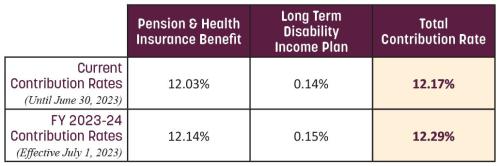
The total contribution rate for FY 2023-24 will be 12.29%. The slight increase of less than two-tenths of one percent is due primarily to lower-than-expected returns on the ASRS fund last fiscal year. The ASRS total fund rate of return was 1.1% for the fiscal year that ended June 30, 2022. The expected long-term rate of return is 7%. The ASRS 10-year average rate of return is 8.9% as of June 30, 2022.
At the end of each fiscal year (June 30), a valuation of the ASRS benefit plans is undertaken by an outside actuarial firm. Guided by the ASRS Funding Policy, the valuation and the recommended contribution rate for the new fiscal year are presented to the ASRS Board of Trustees for adoption.
Contribution rates as a percent of pay, which are paid equally by the member and employer, are actuarially determined and adjusted annually to ensure the plan remains fiscally sound and meets current and future obligations.
There are two portions to the ASRS contribution rate: the Pension & Health Insurance Benefit, and the Long Term Disability Income Plan. The Pension Plan contribution is a pre-tax deduction, and the Long-Term Disability deduction is post-tax. Tax on pension benefits is deferred until payment is made to the member as a benefit or refund.
The two main components of the contribution rate are the contributions required to fund the normal cost of the pension benefit for the year, plus the contributions needed to make up for any previous shortfall that may have occurred. This would include past years when returns fell below expectations, and factors in changing assumptions and demographics, such as increased life expectancies.
A primary goal related to contribution rates, as outlined in the Funding Policy, is to mitigate contribution rate volatility from year to year while keeping the ASRS on a path to a fully funded status.
Minor fluctuations in the rate are expected over the next several years, with a gradual decline over time.
by Dave Cannella, Public Affairs