News
Director Matson featured in Canadian investment magazine
Director Matson featured in Canadian investment magazine
ASRS Executive Director Paul Matson was recently featured in Benefits Canada, a leading multi-media platform covering the pensions, benefits and investment industry in Canada.
Paul, a native of Canada, held various investment positions in Canada prior to joining the ASRS in 1995.
See: Canada’s lasting influence on Arizona’s public sector pension investor
The feature comes after Paul was asked to speak at the industry’s conference late last year in Scottsdale.
See: 2022 IIC coverage: A Canadian view of the Arizona State Retirement System
(Reprinted with permission)
An Overview of our Board of Trustees
An Overview of our Board of Trustees
As with many organizations, the ASRS is governed by a Board of Trustees. Our nine-member board is appointed by the Arizona governor and confirmed by the state senate. Its role, as outlined in state statute, is to provide oversight of the ASRS and act as fiduciaries solely for the benefit of members and beneficiaries.
Five of the nine trustees must be members of the ASRS:
- An educator
- An employee of a political subdivision
- A retired member
- An employee of the state
- An at-large member representing any ASRS member group
The other four trustees are not members of the ASRS and represent the public.
In addition to the Board of Trustees, three smaller committees meet periodically. These committees are the Investment Committee, the Board Appeals Committee, and the Operations, Audit, & Legislative Committee.
(To learn more about the Board of Trustees or its committees, browse our Governance Handbook, which covers everything from the overall conceptual model to the board’s code of ethics.)
Where To View Public Meetings
The board and committees meet throughout the year to discuss various agenda items. By the end of 2023, the ASRS will have held twenty-one public meetings, barring any changes to the schedule that may occur over the rest of the year. All these meetings are open to the public for in-person attendance at our Phoenix office or watched live on YouTube.
While these meetings have always been open to the public, streaming them live on YouTube and making the recordings available afterward is a relatively new feature, with our first public meeting livestream happening in May 2022.
Livestreamed meetings can be viewed on our YouTube page. If you subscribe to our channel, you’ll also be notified when the ASRS goes live. Typically, we start the video feed right at the scheduled time of the meeting. Once ended, we add a link to the video on our website, and also add it to our Board & Committee Meetings playlist on YouTube for those who wish to watch it later.
To see who is on the ASRS Board of Trustees, read short trustee biographies, view the upcoming schedule of meetings, or view information from previous meetings, make sure to visit our ASRS Board of Trustees page.
Written by Nathaniel Brengle, Strategic Communications
Published 5/2023
Summer School & Your Pension
Summer School & Your Pension
As many of our members are school staff and work less than 12 months a year, the question of how working extra over the summer affects your future pension is a common one.
First, a quick note about how non-12-month school staff earn service credit. Because of the shortened work year, these ASRS members earn more service per month (.111 credit per month) than a traditional 12-month employee (.083 credit per month). This is to make sure that non-12-month members earn a full year’s worth of service between the start and end of their school year.
This brings us to how much service credit is earned over the summer by working “extra.” If you’ve already earned your full years’ worth of service credit for the fiscal year, working the summer won’t award you any additional service credit. Due to state statute (§ 38-739), ASRS members are not allowed to earn more than one year of credited service in any fiscal year. So, if you’re wanting to hit retirement eligibility sooner by working over the summer and earning extra credit, that’s unfortunately not how it works.
The second part of working over the summer is about the additional salary. Will working the summer and boosting your yearly income give you a larger benefit when you retire?
Maybe.
It really comes down to how close to retirement you are. If you’re early in your career and more than 10 years away from retirement, working summer school won’t impact your pension benefit. As mentioned in our Pension Benefit Formula article, your benefit is calculated using only the last 10 years of your contribution history… and even then, our calculations are based on your highest consecutive 36 or 60 months’ salary within that ten-year period, depending upon your enrollment date. If you work summer school and then work another 11-plus years, that summer school won’t get included in our calculations.
This isn’t all to say that working over the summer can’t help your pension benefit; in the correct circumstances, it can help increase your lifetime monthly benefit. But it’s important to understand the rules around how service credit is earned and how Average Monthly Compensation (AMC) is utilized to calculate your benefit.
To learn more:
ASRS Statement on Silicon Valley Bank/Signature Bank Issues
ASRS Statement on Silicon Valley Bank/Signature Bank Issues
The Arizona State Retirement System is providing the following information with regard to the receivership of Silicon Valley Bank and Signature Bank as they relate to the ASRS investment portfolio.
The ASRS had relatively small index-like investments in shares of SVB Financial Group (the parent company of Silicon Valley Bank) and Signature Bank.
Specifically, the value of the ASRS investments as of close of business December 30, 2022 were $3.8 million in SVB Financial Group and $2.1 million in Signature Bank. The sum of these two amounts - $5.9 million – is approximately 0.012% of the approximately $49 billion ASRS portfolio, and has been more than offset from much larger investment gains throughout the rest of the portfolio.
As a result, even after paying all the pension, health and long term disability benefits, the ASRS portfolio is approximately $500 million larger than it was at the beginning of the current fiscal year, July 1, 2022.
In addition, the ASRS maintains significant liquidity in different forms and at different levels within the investment portfolio and has not needed to adjust any strategies or investments for any liquidity-related needs.
ASRS staff will continue to monitor and react to various aspects of the financial markets on an ongoing basis.
Resolved: Secure Site Error Message
Resolved: Secure Site Error Message
It came to our attention that, due to a technical issue, some members received an error message when submitting documents in their secure myASRS accounts for a short time between 11/18 - 11/20. Please know this issue has been resolved. For anyone who experienced issues, we encourage you to log into your account and resubmit your documents.
For retirees enrolling in health insurance, our Open Enrollment Period remains open, with the last day being Wednesday, November 30, 2022.
We apologize for any inconvenience.
Awards for Financial Reporting, Funding and Administration
Awards for Financial Reporting, Funding and Administration
ASRS recognized for Financial Reporting and Plan Funding & Administration
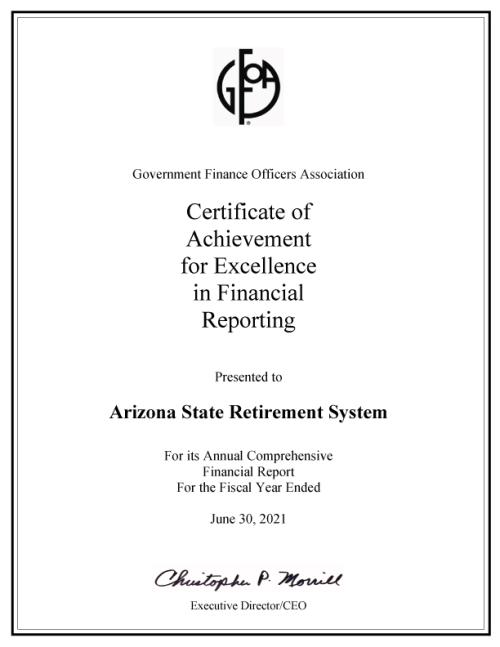
The Arizona State Retirement System recently received the Certificate of Achievement for Excellence in Financial Reporting for its 2022 Annual Comprehensive Financial Report.
Presented by the Government Finance Officers Association of the United States and Canada (GFOA), it recognizes “achievement in the highest standards” for government accounting and financial reporting. It is the 33rd consecutive year the ASRS has received this prestigious recognition. The report was judged by an impartial panel and deemed to meet the high standards of the program, which includes demonstrating a constructive "spirit of full disclosure" to clearly communicate the financial picture of the ASRS. The GFOA is the professional association of state/provincial and local finance officers in the United States and Canada, and has served the public finance profession since 1906.
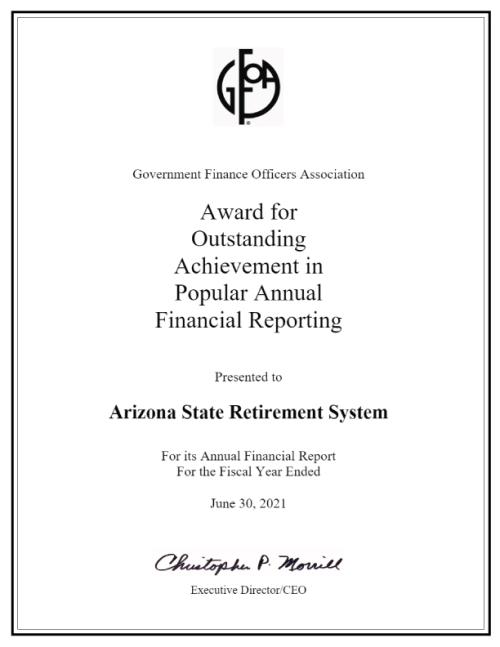
The ASRS was also recognized by the GFOA for its Popular Annual Financial Report, a summarized, reader-friendly version of the comprehensive report. Both reports, which are for the fiscal year ended June 30, 2021, can be viewed on our Annual Reports page.
Separately, the ASRS has also been recognized with the Pension Standards Award for 2022 from the Public Pension Coordinating Council. The award recognizes the ASRS for “meeting professional standards for plan funding and administration.” The standards as set forth by the PPCC cover such areas as benefits, funded status, plan valuation, investment policies and member communications. It is the 18th consecutive year the ASRS has received this award. The Public Pension Coordinating Council is a confederation of the National Association of State Retirement Administrators, the National Conference on Public Employee Retirement Systems, and the National Council on Teacher Retirement.
.

Retiring Before 65?
If you’re early in your career, you may think “retiree health insurance” isn’t a topic you should be terribly concerned about at the moment, but you might be surprised! If you plan on retiring before 65, when most are eligible for Medicare, then health insurance costs could be something you want to start thinking about now.
Simply put, medical insurance is much more expensive for retirees who are not yet eligible for Medicare than for those who are. For 2023, for example, coverage for a non-Medicare retiree through an ASRS plan will be $711 to $1258 a month more expensive than coverage for a Medicare-eligible retiree.

If the premiums for non-Medicare plans seem high, you may be surprised to learn that this is probably in the neighborhood your total health insurance costs today. The primary difference is that when you are working, your employer typically picks up a large share of the total cost of healthcare as an employee benefit. When you retire, this is no longer the case until you become eligible for Medicare, when your healthcare will again be subsidized - this time by the federal government.
What should you do with this information right now?
Think about what age you’ll be when you’d like to retire. If it’s before you’re 65, consider how you’ll pay for insurance.
-
- Open A Savings Account. You may decide you want to start saving now to make it easier to pay for insurance when you’re older. Visit our Supplemental Savings page to see what plans we offer, or talk to your employer to see what plans they may offer as well.
- Plan on a 2nd career. If you plan on working after you retire from the ASRS, you may be able to get affordable insurance through your future employer.
- Coverage through a spouse. You may be able to get more affordable future coverage by joining a plan through a spouse.
Whatever the plan, the important part is not being surprised. The average ASRS retiree is near the age of 60, meaning this is a situation retirees are figuring out how to navigate all the time.
If you’re in the later stages of your career, we always have health insurance rates for retirees available on our website, so you can keep tabs on what rates look like as you get closer to retirement – just visit the Healthcare page of the Retiree section.
For those who may be on the verge of retirement now but are worried because you’ll be retiring after our November open enrollment period ends: You’ll have the opportunity to enroll in an ASRS health insurance plan upon retirement. Retiring is considered a “qualifying life event,” meaning you will have the opportunity to sign up for insurance even if your retirement happens outside our annual open enrollment period.
Contributions: Pre- or Post-Tax?
Contributions: Pre- or Post-Tax?
Your ASRS contribution rate actually consists of two main parts: the “Pension and Health Insurance Benefit” rate, which is a pre-tax deduction from your paycheck, and the “Long Term Disability Income Plan” rate, which is a post-tax deduction. If you look at your paystub, the pre-tax deduction is listed as “ASRSRET” while the post-tax deduction is labeled “ASRS LTD.”
You’ll also notice that your post-tax contribution is a fraction of your pre-tax contribution. This is because the pre-tax Pension and Health Insurance Benefit rate makes up the vast majority of your total contributions – 11.86% of the total 12.00% contribution rate for FY 2025-26. These pre-tax contributions are what fund the majority of our primary benefits, including your possible future pension benefit.
The immediate advantage of having most of your contributions deducted pre-tax is that it lowers the taxable income of your paycheck. Fewer taxes are taken out of your paycheck by paying contributions pre-tax than if the same percentage of contributions were taken out of your paycheck post-tax. But it’s also essential to understand one other effect of these pre-tax deductions: taxes being taken out once you begin to receive a pension benefit.
Some new retirees are surprised to see taxes taken out of their ASRS pension benefit when they start to receive retirement checks, thinking they paid taxes as they were contributing and were now being taxed a second time when receiving their pension. However, as you can see, this isn’t actually the case. Functionally, it’s similar to how most all pre-tax retirement savings plans function, such as a 401(k), in which taxes are paid when you eventually begin to withdraw funds in retirement.
Want more information about contributions? Visit our Contribution Rates page for answers to common questions such as how rates are determined, why contribution rates fluctuate, and more.
Updated: 7/28/2025
New ASRS Member? Welcome!
New ASRS Member? Welcome!
We have revamped our New and Prospective Members page! Located in the Members tab, we designed this page to help introduce you to who we are, guide you through the myASRS account registration process, learn more about your member benefits, understand ASRS contributions, and get answers to commonly asked questions. On the New and Prospective Members page, you'll learn about a few primary benefits available to all ASRS members. Topics include your Lifetime Pension Benefit, Long Term Disability, Retiree Health Insurance, and Survivor Benefits.
Do you have questions about your member contributions? The ASRS funds the benefits we offer our members through member and employer contributions. The New and Prospective Members page provides links to a variety of information and educational videos to help explain how the contribution rate is determined, how often it fluctuates, and what benefits it helps provide.
The biggest benefit your contributions provide is a possible retirement benefit. While retirement may not be on your radar right now, it's important to understand what you're working towards – a guaranteed lifetime monthly benefit! This is just one of the benefits you can learn about on the New and Prospective member page.
As a new member, we want to welcome you to the ASRS and help you along your journey. If you would like to stay better connected to us and other ASRS members and retirees, follow us on Facebook, Twitter, and YouTube! We often highlight commonly asked questions and feature videos and articles aimed at all our members, from newly hired to mid-career through retirement.
by Aubrey Wilson, Strategic Communications
ASRS Risk and Compliance
ASRS Risk and Compliance
Every day, we are all exposed to some type of risk, whether it’s from walking down the street, driving to the store, running a business, or investing in the stock market. Risk is multi-dimensional, in that it means different things to different people or organizations, who have differing tolerance for a particular risk.
At the Arizona State Retirement System (ASRS), we pay particular attention to Investment Risk. The risk-reward for various types of investments – stocks, bonds, etc. – are analyzed to determine a mix that produces the optimum return on our total fund for an acceptable level of risk.
This is in line with our primary objective of ensuring adequate funds to pay current and future benefits to our retired members, members on disability, and beneficiaries, as well as mitigating contribution rate levels and volatility for our members and employers.
Investment Risk
The ASRS accepts investment risk with an expectation to be rewarded by the returns of investing. We take into account the overall economy, business cycles, and capital markets. The growth or slowing of the economy creates risks and opportunities. Inflation for instance is a risk to businesses, which may need time to adjust to changing prices. Economic contractions are another source of risk, especially for businesses which lack the resources to ride out a recession. When investors seek safety during a recession, this causes prices of capital assets to decrease, especially if stressed investors become compelled sellers of assets.
All of this is a source of opportunity for institutional investors such as the ASRS, who are long-term oriented and have the resources and time horizon to ride out market declines. This is certainly a different risk tolerance than for an individual with a 401(k) account that is nearing retirement age.
Still, the ASRS mitigates investment risk through a well-diversified portfolio across investable asset types, geography, and characteristics that drive returns.
ASRS staff, in concert with our general investment consultant, conducts an asset/liability study every several years for the purpose of determining an investment allocation that maximizes the expected long-term returns of the fund while minimizing the level and volatility of contribution rates for our employees and employers. This study is presented to the ASRS Board’s Investment Committee and then the full Board for detailed review and discussion. The Board then makes the decision on the final investment mix and performance benchmarks, and charges staff with timely implementation, while allowing staff significant flexibility with respect to short-term or ‘tactical’ re-allocations, investment structures, and investment strategies.
The ASRS is in the final stages of completing such an asset/liability study and expects a new, modestly changed investment allocation later this fall.
Compliance
The role of compliance in the management of the ASRS investment portfolio is multifaceted and diverse.
At a high level, the compliance function is tasked with ensuring that all investment activities comport with federal laws and regulations, state laws and rules, Board policies, and ASRS’s internal standard operating procedures. As an example, under the U.S Department of Treasury, the Office of Foreign Asset Control (OFAC) administers a list and enforces sanctions against countries and individuals engaging in terrorism or narcotics trafficking. The ASRS compliance function runs continual screens on the various investments to ensure compliance with OFAC, as well as other federal regulations. Similarly, compliance is also charged with monitoring State of Arizona statutes which govern specific investment limits in the management of the ASRS investment fund.
At the investment portfolio level, the compliance function plays a key role in monitoring ASRS policies and procedures, including those which govern external investment manager and partner selection, tactical positioning, rebalancing, securities litigation, internal portfolio management, including pre-trade and post-trade compliance, and verification of asset management fee calculations, to name a few.
In much the same way that investment risk is inseparable from returns, good risk management is inseparable from compliance.
You can learn more about investments and compliance by visiting the Investments section of the website.
by Michael Viteri, Chief Investment Officer