News
Social Security: More Than Just Retirement Benefits!
Social Security: More Than Just Retirement Benefits!
How much do you know about Social Security? Regardless of your age, it’s good to have a foundational knowledge of what it is and what it provides – including disability benefits, survivor benefits and, of course, retirement benefits. In fact, Social Security is a fundamental part of your retirement plan! The ASRS is meant to be only one part of your financial retirement picture, with Social Security and personal savings making up the rest.
If you’re curious about how much your future social security benefit might be, create an account and find out! Whether you’re 20 or 60, you can visit SSA.gov, create your account, and see a snapshot of how much you’ve earned over your working career, along with projections of what your Social Security benefit may look like.
If you’re close to 60, you may want to start planning on when to take Social Security: you can start taking a benefit at an earlier age for a reduced amount or decide to wait to increase your monthly benefit.
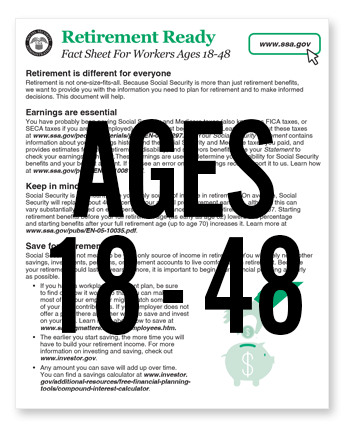
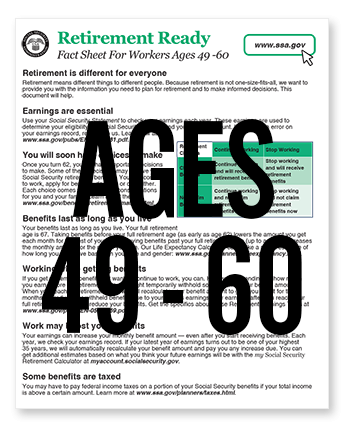
For more information on Social Security, view the age-specific fact sheets below and visit ssa.gov!
Who Gets Your Money?
Who Gets Your Money?
The ASRS currently serves over 660,000 members, including retirees, active members, and inactive account holders. With that many members, complicated account situations are not uncommon. One of the most frequent is when a family member contacts us after a member’s death, trying to manage the now-deceased member’s ASRS account. What can make this situation particularly difficult is when the deceased member never registered their myASRS account and did not list any beneficiaries.
While the ASRS can help resolve these issues, missing information in a deceased member’s account can cause unnecessary delays and complications during an already difficult time. It may also result in the account being distributed in a way that doesn’t reflect the member’s wishes.
If a member does not have a beneficiary on file, Arizona law directs the ASRS to distribute benefits in this order:
1. Surviving spouse
2. Surviving children (including adopted) in equal shares
3. Surviving parents
4. The member’s estate
Keeping your ASRS account up-to-date, especially registering your myASRS account, maintaining accurate contact information, and designating beneficiaries, can make a meaningful difference for both you and your loved ones and help avoid potential complications or delays in the future.
For more information, visit “Choosing Beneficiaries” where we have additional resources, including frequently asked questions, or log into your secure myASRS account.
Retiring Young
Retiring Young
If you’re eligible for full, normal retirement at a young age, there’s a lot to consider. Some examples include planning for health insurance, preparing to access personal savings or Social Security, or even beginning a second career after retiring. We’ll look closer at each of these elements to help provide a better understanding of the choices that come with retiring.
For our purposes, we’ll define “retiring young” as retiring before the age of 65, because this is when most have become eligible for Medicare – which can be a big factor when thinking about retirement.
Health Insurance
Many don’t realize how expensive health insurance can be when they aren’t yet eligible for Medicare, or when they don’t have an employer subsidizing their health insurance. To give an example of the possible disparity between Medicare-eligible and pre-Medicare medical insurance rates: for plans offered through the ASRS beginning in 2025, premiums range between $96.38 and $199.26 a month for a single-coverage Medicare plan (a plan that covers only you – no spouse or dependents) while rates for single coverage non-Medicare ASRS retirees are between $660 and $1,290 a month1 That’s a huge difference, and one that catches a lot of people off guard!
If you plan on retiring early, be mindful of how you plan to obtain health insurance. Will you have a working spouse whose plan you can join, or will you start a second career and get insurance through your future employer? Both are options that could save you money.
Personal Savings
Your ASRS pension is meant to be just one part of your overall retirement income, with personal savings and Social Security rounding out your retirement finances. However, even if you have a well-funded supplemental savings account, such as a 401(k), you might find you can’t withdraw funds without a financial penalty if you aren’t 59 ½ years old when you retire. A 10% penalty is common for these types of savings accounts, in addition to the typical taxes and fees involved. You may need to decide whether you’re willing to accept the penalty or wait to access these funds. Either way, make sure to research the rules specific to your type of savings account so you‘re better prepared when you retire.
Also, unlike your ASRS pension, which is guaranteed for life, personal savings are a finite resource – if you start withdrawing from it earlier than you initially planned, it could run out.
Social Security.
If Social Security is part of your retirement strategy, you’ll also need to research how early you are able (and willing) to take it. The age at which you can receive full benefits varies, falling between 66 and 67 depending on your age. The earliest you’re able to receive Social Security benefits is age 62, and you’ll be taking a reduced benefit – an estimated 29% lower benefit than what your full Social Security would be. Also, Social Security benefits vary from person to person depending on work history, age, and how much you’ve paid into Social Security. To get an idea of how much your Social Security benefit could be, visit SSA.gov, where you can use their online estimator to see a personalized estimate of your future benefit.
Starting a Second Career
This is often the solution for those who can retire at a young age with the ASRS, and may solve many of the potential hurdles we’ve already discussed. Receiving a paycheck from an employer and your ASRS pension2 could bridge the financial gap, allowing you to leave your personal retirement savings alone (or even keep adding to it) until there’s no penalty to withdraw, while also allowing you to wait to take Social Security benefits. If you work for an employer that offers health insurance, it could also help you avoid those high, unsubsidized non-Medicare health insurance rates.
Whether you’re thinking of retiring this year or in five years, at age 45 or 70, it’s never too early to start forming a plan! You could even find that the best option is to delay your retirement if you're close to hitting the next multiplier in your pension calculation3 For additional food for thought visit our thought visit our Retirement Central page at AzASRS.gov.
1 These are rates the ASRS has currently negotiated with UnitedHealthcare for Plan Year 2025. There are many places to source health insurance with varying levels of coverage and rates, but you’re likely to find a similar level of cost disparity between Medicare and non-Medicare medical plans. Once on Medicare, the government starts subsidizing your health insurance costs, allowing insurance companies to offer much lower monthly premiums than to those not eligible for Medicare. Back
2 Visit our Return To Work page for additional info on working after retirement.
3 Graded Multipliers are part of your pension calculation, with the multiplier increasing the more years of service you have. For more information, visit our Estimate Your Benefits page
Working After Retirement
Working After Retirement
Retirement doesn’t always mean not working. And returning to work doesn’t necessarily mean you have to pause receiving your pension – you just need to be aware of the rules regarding your ASRS pension benefit and returning to work.
Working For a Non-ASRS Employer
The simplest way to navigate working while also collecting your ASRS pension is to work for a non-ASRS employer or as a temporary employee for an ASRS employer. ASRS statutes and rules regarding returning to work after retirement pertain only to returning to work directly with an ASRS employer. If you’re not working for an ASRS employer, you can work as much or as little as you’d like and your ASRS benefit will remain unaffected, and you do not need to notify the ASRS.
Working For an ASRS Employer
For the first 365 days following your termination date, you may return to work directly for an ASRS employer and continue to receive your pension, provided you retired at normal retirement (not early retirement), and:
- Work less than 20 hours per week; or
- Work 20 hours or more a week for no more than 19 weeks in the fiscal year (this is called “the 20/20 Membership Criteria.”) The remaining 33 weeks in that fiscal year must be below 20 hours per week to retain your pension.
After 365 days, you’re eligible to work unlimited hours and continue to draw a pension benefit as long as you retired at normal retirement and terminated your employment with all ASRS employers at your time of retirement. (Members who retired but did not terminate employment must remain under the 20/20 Membership Criteria for the duration of their post-retirement employment if working for an ASRS employer.)
For more comprehensive details on the ins and outs of returning to work, visit the “Return to Work” page of AzASRS.gov, found in the “Retirees” tab. There you’ll discover situation-specific information, statute language, and a link to log into your secure myASRS account. Inside your secure account, you can access our Working After Retirement tool designed to assess how the rules apply to your particular situation.
by Nathaniel Brengle, Strategic Communications
Your Retirement Publication - Q2 2021
Will my Pension Ever Increase?
Will my Pension Ever Increase?
One of the most common questions we receive from retirees relates to increases in their pension. Many retirees are surprised to learn that the ASRS was not designed to provide yearly post-retirement benefit increases.
The ASRS, by statutory design(1) is meant to be one of three forms of retirement savings in a member’s overall retirement portfolio (ASRS pension, Social Security, and personal savings). This is commonly referred to as the three-legged stool. As a member of the ASRS, retirees have already contributed to ASRS and Social Security. Most also had access to supplemental retirement savings programs during their working career.
If you’re asking what this means in practical terms and whether your pension will ever increase, the short answer is: possibly. Here is what the ASRS defined benefit plan does and does not include as it relates to postretirement benefit increases:
Cost of Living Adjustments (COLA’s)
There is no provision in the design of the ASRS plan for retirees to receive COLAs, nor did your contributions ever fund one. A COLA is a benefit provision designed to offset the effects of inflation. The design of the ASRS plan instead assumes you will receive a COLA through your participation in Social Security(2) and that you will also have some personal savings available to guard against the effects of inflation.
Permanent Benefit Increases (PBI)
The ASRS does have a provision to provide a permanent benefit increase to retirees if investment experience meets the conditions to grant one.
Who is eligible for a PBI?
• Eligible: If the date you first joined the ASRS is prior to September 13, 2013, you are eligible for a PBI and will receive one if conditions permit, and you have been retired for more than one year.
• Not Eligible: If the date you first joined ASRS is on or after September 13, 2013, you are not eligible for a PBI. Any post-retirement benefit increase for this group would need to be granted by the legislature.
For eligible retirees: What conditions are needed to trigger a PBI distribution?
• When the 10-year actuarial returns exceed 8%, excess earnings are placed into a separate fund for PBIs.
• When the fund is sufficient to pay a permanent benefit increase to eligible retirees, a permanent benefit increase is paid.
How is the PBI calculated?
When conditions for a PBI are met, the actuary will determine: how much is available, who is eligible for an increase, and the dollars per year of service used in the calculation. The calculation is: (Dollars x Years of Service) divided by 12 = monthly increase
($$ x Y of S) / 12 = MI
When will eligible retirees receive a PBI?
In the past several years, the ASRS has met the threshold to put a small amount of excess funds aside for future PBIs. A PBI was recently made possible and was applied to eligible retirees beginning with their July 2022 benefit check. Based upon the plan's actuarial valuation for fiscal year ending June 30, 2022, there are insufficient funds to provide for a Permanent Benefit Increase for the new fiscal year, which begins July 1, 2024. If market conditions are favorable over the next several years, we are hopeful that the PBI fund will be sufficient to pay a PBI to eligible retirees. |
(1) Arizona Revise Statute 38-712 can be found online at www.bit.ly/38-712
(2) Information on Social Security’s cost-of-living adjustment for 2021 can be found at SSA.gov/cola
by Sara Orozco, Strategic Planning
Updated 1/22/2024
Getting the Most From Your MyASRS Secure Account
Getting the Most From Your MyASRS Secure Account
Your secure myASRS account is an important tool both before and after retirement. After you retire, it’s important to stay active in your account; here is a brief overview of all the capabilities you have within your myASRS account as a retiree.
Within your secure myASRS account, you can update or change your contact information, direct deposit, and tax withholdings. We often get emails from retirees wanting their address and contact information updated - although for security reasons we cannot do this for you, making this change yourself in your secure account is an easy and straightforward process. The same is true if you change banks or want your pension deposited to a new account. You can also easily change your tax withholdings here if you have determined that you are withholding too much or not enough taxes from your pension.
Your secure myASRS account is also the place to view or print your monthly payment history, pension verification, or access an Authorization to Release Information form. To be more environmentally friendly, the ASRS no longer mails payment histories; however, they are easily accessible in your secure account. Refinancing or making a big purchase for which you need to verify your income? This is the spot to print the necessary pension verification. This is also where you go to verify the type of annuity you chose when you retired, and to check that your beneficiary(ies) on file are still correct and current.
Your secure account is also your hub for retiree health insurance. If you already have medical and/or dental insurance through the ASRS, you can come back to verify what you are signed up for, and if you’ve had a “qualifying life event” or it’s during the open enrollment timeframe, you can use your secure myASRS account to sign up for insurance with the ASRS.
Finally, this is also where you can access secure messaging. Just like when you were an active, contributing member, you can still utilize Member Secure Messaging to ask questions or securely send us documents.
So, even as an ASRS retiree, if you have a question or need to update, change, or print any documentation related to your ASRS pension, chances are you can find what you are looking for within your secure myASRS account! |
by Benjamin Robinson
Strategic Communications
Managing on Behalf of our Members
Managing on Behalf of our Members

Below is a formula that is very important at the ASRS, but is one that most of us would not learn about outside of retirement fund management:
C + I = B + E
In the formula above, the letters refer to Contributions, Income, Benefits and Expenses – and this is the essence of how your retirement system is funded! A description of these four factors follows.
“Contributions” refers to the deductions that are equally paid by employees (often called active members) and their employers. These contributions are collected with every payroll and then invested by the ASRS.
“Income” refers to all the interest, dividends and capital gains that are generated by investing the contributions. This income is generated because the contributions collected are invested by the ASRS in various bonds, stocks, real estate and other investments in order to create a diversified investment portfolio that maximizes expected returns while minimizing expected risk. The higher the rate of return the ASRS can generate from this portfolio, the lower the contribution rates for employees and employers, and the higher the probability that the ASRS can pay out additional future increases (Permanent Benefit Increases – or PBI’s) to retirees. Over the ten year period ending June 30, 2020, our average annual rate of return has been 8.9%, placing the ASRS in the top 10 percent of our public pension plan peers in terms of total returns. We will report our June 30, 2021 returns as soon as they are finalized.
“Benefits” refers to the various payments that are made to former employees, typically paid in the form of pensions, health insurance supplements, disability payments and refunds. These payments are the reason the ASRS exists, and everything else we do – investment management, accounting, systems development, member services, strategic planning – is done to support a cost-effective system of paying benefits to our members.
“Expenses” refers to the investment and administrative costs of managing the retirement system. The lower the cost of providing all the various retirement, health insurance, disability and other services the better. In order to ensure focus on this area, the ASRS engages an independent external company (CEM Benchmarking Inc.) to measure both ASRS customer service and ASRS administrative costs. The results for the most recent year indicate that the ASRS again has low costs and high service - with an ASRS service score of 92 versus the peer median of 79, and with an administrative cost of $72 per active and retired member versus the peer average of $105, resulting in the ASRS being approximately 31 percent less administratively expensive than our peers. This low-cost high service model has been achieved by a combination of organizational philosophy, long-term planning, action orientation, and a marginal cost versus marginal benefit approach to decision-making and resource allocation.
We believe that this model has served members well and will continue to do so. This approach is at the core of maintaining a sustainable benefit plan for our members.
If you’d like to learn more about the ASRS, please visit our website at AzASRS.gov.
To all of our valued members - thank you for your service to our State, and for the trust you have put in the ASRS.
Sincerely,
Paul Matson, Executive Director
The Retirement System Equation
The Retirement System Equation
A formula that is very important at the ASRS, but one that most of us would not learn about outside of retirement fund management:
C + I = B + E
Contributions plus Income equals Benefits plus Expenses. This is the essence of how your retirement system is funded! A description of these four factors:
Contributions
This refers to the deductions that you and your employer equally pay. These contributions are collected with every payroll and then invested by the ASRS.
Income
Income refers to all the interest, dividends, and capital gains that are generated by investing the contributions. This income is generated because the contributions collected are invested by the ASRS in various bonds, stocks, real estate and other investments in order to create a diversified investment portfolio that maximizes expected returns while minimizing expected risk. Over the ten year period ending June 30, 2020, our average annual rate of return has been 8.9%, placing the ASRS in the top 10 percent of our public pension plan peers in terms of total returns. We will report our June 30, 2021 returns as soon as they are finalized.
Benefits
Benefits refers to the various payments that are made to retirees, long-term disability recipients, and members who withdraw/refund, typically paid in the form of pensions, health insurance supplements, disability payments, and refunds. These payments are the reason the ASRS exists, and everything else we do – investment management, accounting, systems development, member services, strategic planning – is done to support a cost-effective system of paying benefits to our members.
Expenses
Expenses refers to the investment and administrative costs of managing the retirement system. The lower the cost of providing all the various retirement, health insurance, disability, and other services, the better. To ensure focus on this area, the ASRS engages an independent external company (CEM Benchmarking Inc.) to measure ASRS customer service and ASRS administrative costs. The results for the most recent year indicate that the ASRS again has low costs and high service - with an ASRS service score of 92 versus the peer average of less than 79, and with an administrative cost of $72 per active and retired member versus the peer average of $105, resulting in the ASRS being approximately 31 percent less administratively expensive than our peers. This low-cost, high service model has been achieved by a combination of organizational philosophy, long-term planning, action orientation, and a marginal cost versus marginal benefit approach to decision-making and resource allocation.
We believe that this model has served members well and will continue to do so. It is the core of maintaining a sustainable benefit plan for our members, and we look forward to being a part of your future retirement!
A Service Purchase Overview: Types & Price
A Service Purchase Overview: Types & Price
The ASRS Service Purchase Program is a benefit that allows active members with previous qualifying service to purchase past service time. There are 5 types of qualifying service, with the most common being the purchase of Forfeited Service or the purchase of Other Public Service. While it can be costly, it can also be beneficial - potentially increasing your lifetime benefit and/or allowing you to retire earlier than planned.
Forfeited Service
Members who are eligible to purchase forfeited service are those who have previously terminated employment with an ASRS employer, took a refund of their contributions, are now working directly for an ASRS employer, and making contributions again. A common misconception is that purchasing this type of service just means paying back the amount initially refunded. In reality, buying previously forfeited service costs more than the original refunded amount, as you’ll need to pay back the original refunded amount plus interest that would have accrued, had the funds remained in the ASRS.
If you do find yourself in the position of leaving your ASRS employer and are thinking about refunding your account, we encourage you to visit the Refunding page of AzASRS.gov to get more information and weigh the pros and cons. (Or read our article, “Should I Refund My ASRS Account?”)
Other Public Service
There are two types of employment that can be purchased under this category. If you were previously employed by a public, non-ASRS employer, such as a federal, city, county, state, political subdivision, school or university employer, you may be eligible to purchase some of that time so it applies towards your ASRS retirement. There are some stipulations. For instance, if you participated in that previous employer's retirement system, you would be required to relinquish your rights to any benefits from the previous employer’s retirement system prior to purchasing that service with the ASRS.
This is also the category that covers people who may have worked for an ASRS employer but were not contributing members for a period of time. Most state agencies, for example, have a 6-month waiting period from when an employee is first hired to when they start contributing and become members of the ASRS. Once they’ve been contributing members for 5 years, those employees can purchase those 6 months of service. Additionally, if you worked for an ASRS employer but didn’t meet ASRS membership criteria by working at least 20 hours per week for 20 or more weeks in the fiscal year, you would also be able to purchase any time in which you were working for the ASRS employer but not contributing. (Note: Members cannot purchase service for any months in which they have already received service credit with the ASRS.)
Other Types Of Service Available for Purchase
Military Service, Leave of Absence, and Contributions Not Withheld are all additional categories of service purchase. To read more about each type, visit our Service Purchase page. There you’ll also find a helpful Frequently Asked Questions section that covers a variety of helpful topics.
Cost
How much does purchasing service cost? That depends. For starters, there are different methods of calculating cost depending upon the type of service purchase you qualify for. Additionally, your age, current salary, years of service, and the amount of time you’re looking to purchase can all affect cost. For Other Public Service, Military Service, and Leave of Absence, how early or late into your career you purchase time will also affect the price. For these particular service types, cost is determined by calculating how much money we need now in order to pay out the benefit increase that your purchased time will provide when you retire. The earlier you purchase your time, the longer the ASRS has to invest and grow the money you’ve paid before you retire, and the less it’ll cost.
The best way to receive an estimate of how much it will cost is to log into your secure myASRS account and start the service purchase application process, during which you’ll be provided with pricing and payment options. Don’t worry about submitting a request in error because there is no obligation to purchase any request that you submit online, should you decide it is not the right price or circumstance for you. Going through the service purchase application just to see how much it might cost is completely okay – even encouraged!
For additional information on service purchase, payment options, and frequently asked questions, make sure to visit our service purchase page at AzASRS.gov.
Leaving The ASRS and Cash Refunds: An Example
Leaving The ASRS and Cash Refunds: An Example
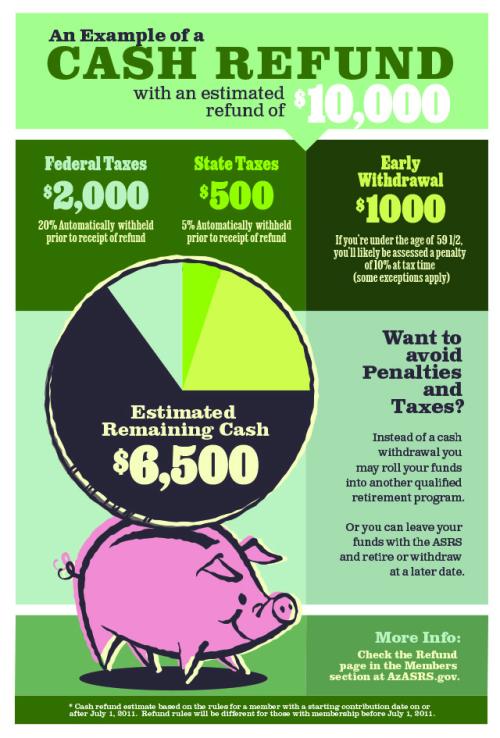
In this infographic, we look at an example of an ASRS member with an estimated refund of $10,000 to see how taxes apply, what penalties may be assessed, and what the estimated remaining cash amount could be (along with options available to avoid those penalties and taxes).
Note: refunding your ASRS account is only an option for those who have ended employment with all ASRS employers. Under state law, active, contributing ASRS members are not allowed to withdraw, refund, or borrow against their ASRS account.
Additional Resources on Refunds: