News
ASRS Phone Scam Warning
ASRS Phone Scam Warning
Social Engineers Want Your Data
A note of caution: Please be aware of imposters impersonating the ASRS, calling members and requesting information from them. This type of "social engineering" scam tries to manipulate you to let your guard down by pretending to be a trusted source, such as Social Security or the ASRS.
BE ADVISED: The ASRS will never call you to collect data from you over the phone.
If you receive a call that you suspect to be someone fraudulently impersonating the ASRS, hang up and notify the ASRS.:
- Call the ASRS Fraud Hotline: 602-240-5360
- Email our Privacy Officer: [email protected]
- Log into your myASRS account and send us a Secure Message.
Your privacy is very important to us.
Are You Fully Enrolled with the ASRS?
Are You Fully Enrolled with the ASRS?
One of the first steps you take when you start working for an ASRS employer is enrolling with the ASRS: your employer should have given you their unique employer code and assisted with making sure you did, in fact, get fully enrolled online with the ASRS. It’s a fairly quick online process that makes sure your account is properly affiliated with you. It’s also a step that sometimes gets overlooked when new employees are being set up.
Here's what to do if you've (a) never logged into your myASRS account, (b) have logged into your myASRS account previously, or (c) your correct employer isn't listed when you log into your myASRS account.
A) If you’ve NEVER logged in to your myASRS account at AzASRS.gov (or don’t remember if you have)
Click on myASRS in the top right corner of our website, then click on the “First Time Registering?” link towards the bottom of the page and follow the prompts through the registration process. If you have registered previously and forgot, you will be alerted of that at the end of the process, at which point you should use the “Having Trouble Logging in?” link on the main MyASRS log-in page to recover your login and/or password.
Once registered, log into your account and look to make sure your account information is correct, including what’s listed as your current ASRS employer. If everything looks in order, you’re good to go! Just make sure your beneficiaries are up to date, and remember to periodically check your account to make sure your phone number, email address, and mailing address are all up to date as well.
B) If you HAVE logged into your myASRS account previously
As mentioned above, log into your account and check that all your information is correct and current; your contact information, your listed beneficiaries, and your current ASRS employer. If everything looks correct, no further action is needed!
C) You’ve logged into your account, but your current ASRS employer isn’t listed (or isn’t correct)
If you are a newly enrolled member or just moved to a new ASRS employer, the “Current ASRS Employer” field may be blank or not yet updated. If you just completed the "First Time Registering" steps as a new member or just recently enrolled with a new employer, your employer information will not be updated until your enrollment has been verified by your employer and your first contributions post to your account. Please allow 2 to 3 pay periods for your employer information to appear on your account.
If you've been contributing for a few months now and the employer field is still blank or incorrect, you’ll need to work with your current employer to update it. Start by contacting your employer’s Human Resources department – they should be able to give you an enrollment code. Once you have the enrollment code, visit the main myASRS page, make sure you’re not logged in, and use the “First Time Registering” link once again. It may seem like you’re re-registering your account, but this process will prompt you to enter the enrollment code you’ve received from your HR department. Once you’ve completed this, your employer will go through a process with the ASRS to confirm your account and contributions. After your enrollment is verified and your contributions have been posted, your online account will reflect your correct employer information.
Please note that if you change ASRS employers at any point, or if you’re returning to work for an ASRS employer after you’ve previously forfeited/refunded service, you’ll need to go through this enrollment process again with the new employer’s enrollment code.
Why is any of this important?
For starters, there are security reasons: once registered, you’ll be notified via email anytime someone logs into your account. If you’re not properly enrolled and registered with the ASRS, we’ll have no way of getting ahold of you about your account should the need arise. Being fully enrolled allows you to associate a beneficiary with your account, run retirement estimates, and even submit your retirement application when you're ready. Lastly, because the ASRS collects important demographic information during enrollment, your pension benefit payments may be delayed to you or your beneficiary if the enrollment process is not completed.
To get started, just visit your secure myASRS account!
by Nathaniel Brengle, Strategic Communications
Retiring Within 6 Months?
Retiring Within 6 Months?
If retirement is on the horizon, you may have questions about the process and how to start receiving your lifetime pension. To help answer those questions, the ASRS offers our educational webinar, “Route 4: Next Exit Retirement.” This meeting is for members retiring within six months and is designed to help clarify your retirement choices.
Route 4 is available as an online webinar that allows you to ask questions in real-time with a member of our Member Education team, or as a pre-recorded video. This webinar provides essential information as you approach retirement, including;
- The significance of your credited service years and average monthly salary as an active member
- The various retirement annuity options available to you
- How each annuity option determines the amount of your lifetime benefit.
We illustrate our entire application process to help you understand when and how to apply online and when to expect your initial pension payments. You’ll learn what to expect both leading up to your retirement and after. The meeting also includes a personalized benefit estimate to give you a good idea of your potential monthly pension.
To see a list of upcoming meeting times, visit the Member Education page of our website. Meetings are typically scheduled two months out, with more sessions planned during high-volume retirement time periods. Registration is required and is available through your secure myASRS account. After logging in, select the “Communication & Education” dropdown from the left-hand navigation and follow the prompts to register.
To prepare for your Route 4 meeting, we recommended attending a Route 3: Destination in Sight meeting. The Route 3 meeting lays the groundwork for Route 4. For more information on our Route 3 meeting, visit the member education page. Additionally, there are many other great learning resources on the Member Videos page.
This article was updated 2/8/2023
The Pension Benefit Formula
The Pension Benefit Formula
Have you ever wondered how we calculate pension benefits? There is sometimes the mistaken belief that it may have something to do with your account balance, when in fact it's all about salary and how many years you work. The ASRS uses the following fairly simple formula to calculate the Straight Life Annuity, which is the baseline monthly benefit from which all our other annuity options are derived:
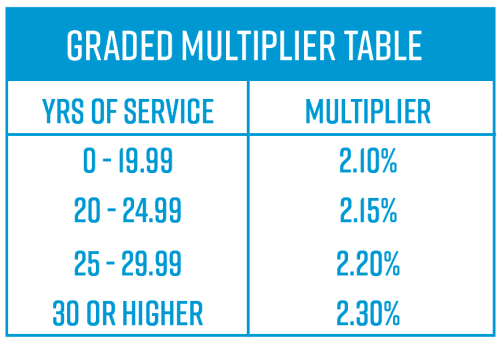
Average Monthly Compensation x Total Service Credit x Graded Multiplier = Monthly Pension
Let's take a look at each part of the equation separately to get a better understanding of how the timing of your retirement affects your pension benefit.
Average Monthly Compensation
To start calculating your pension, the ASRS looks at the last ten years of your contribution history. For people who became a member on 7/1/2011 or later, we'll then take the average of your highest consecutive 60 months within those 10 years. For those who were members before that (but after 1/1/1984), it's your highest consecutive 36 months within those ten years. You can read more about AMC on our Retirement Eligibility page.
Total Service Credit
In short, the more service credit you have accrued, the higher your monthly pension benefit will be. That said, your age also becomes a factor when looking at how many years of service you may need to reach normal retirement. A great way to evaluate your options is to play with the personalized benefit estimator in your secure myASRS account. Note that members who retire early will receive a reduced benefit for their lifetime based on their age and total credited service at retirement.
One important note as you start to narrow in on your retirement date: although your years of service are updated with each contribution applied to your account, the ASRS cannot guarantee your total years of service until a detailed audit is performed on your account, triggered by the processing of your retirement application. We suggest members consider working an additional month past their target retirement date to build a cushion and cover any needed adjustments that could be found during the audit.
Graded Multiplier
Wondering what that "graded multiplier" is? The graded multiplier is one of the major factors used to determine how your pension is calculated. Therefore, it is an important piece in deciding when to retire. The graded multiplier is tiered based on your total years of service. As you accrue more service, you qualify for a higher multiplier of your final average monthly compensation, which increases your benefit. When selecting your retirement date, looking at your service and reviewing if you are close to the next graded multiplier threshold is important. If you are, it could be worth it to work longer to reach the next graded multiplier and increase your benefit for your lifetime.
Personalized Estimates
The ASRS provides a personalized benefit estimate tool in your secure myASRS account. This tool is one of the best ways for you to determine when the best time for you to retire may be. You can see general estimates for your first point of normal retirement, or you can customize the estimate based on a date you select. Log into your secure account and click ‘Retirement’ under ‘Your Benefit Estimates’ to check and customize your own personalized estimate.
How Well Do You Know Your Pension?
How Well Do You Know Your Pension?
Pensions are not as common as they used to be, which can lead to not fully understanding what you’re a part of, how it benefits you, and how to best take advantage of the benefits available to you. To further that understanding, let’s take a look at what the Arizona State Retirement System is, and what it isn’t.
For starters, the ASRS is what’s called a “Defined Benefit Plan.” In technical terms, it’s a 401(a) plan that is governed by Arizona statute and IRS rules. A more simple explanation: it’s a mandatory-participation retirement plan that provides ASRS retirees with benefit payments for the rest of their life. The basic structure for retirement is as follows: ASRS members and employers both pay contributions to the ASRS, the ASRS in turn invests those contributions and pays members who meet retirement eligibility a lifetime benefit payment. That benefit amount can vary based on your age at retirement, years of service, and average monthly compensation. It’s not determined by your account balance with the ASRS or the performance of ASRS investments.

(Note: For a more comprehensive look at how your pension is calculated and how to potentially increase your pension before you retire, make sure to read the “The Affect of 'When' on Your Pension” article.)
When most people think of a retirement savings plan offered by an employer, they think of a 401(k) savings plan. Instead of being a “Defined Benefit Plan” like the ASRS benefit, a 401(k) is classified as a “Defined Contribution Plan.” It’s a subtle but important distinction, and they each operate very differently. For a 401(k) plan, the funds available to you when you’re ready to retire are solely based on your account balance and the performance of investments over the life of the account. Keep in mind that those investment decisions are managed by you, the employee, unlike investment decisions with your ASRS pension, which are professionally managed by the ASRS. There’s also no guarantee that the money in a 401(k) will last as long as a person may need it to. Once the balance of the account has been fully paid out, that’s the end of the benefit. According to the rules of your 401(a) ASRS benefit, your pension will be paid for your lifetime. In fact, it is quite typical for ASRS retirees to receive multiple times more in pension payments than what they actually paid into the ASRS over their career with contributions. This is made possible through the investing of member and employer contributions. Furthermore, Article 29 of the Arizona Constitution protects your ASRS benefit from being ‘diminished or impaired.’
That’s not to say a 401(k) isn’t a valuable savings tools – it’s just important to know the differences. The ASRS even actively suggests members have retirement savings outside of their pension, to help supplement their future retirement benefit. An ASRS pension is designed to be one of a three part strategy for retirement: your ASRS pension, Social Security, and personal savings. This is partially to help guard against future rising living costs. While your ASRS pension is guaranteed for your lifetime, it does not include any means of automatic increases, such as cost-of-living increases. This means you could expect your retirement benefit to be the same amount after you’ve been retired for 20 years as it was when you were retired for two years.
Curious to know how much your pension might be when you retire? It’s easy to find out. If you go to AzASRS.gov and select the Estimate Your Benefits page from the Members drop-down menu, you’ll find additional information on how your pension is calculated, including an interactive tool you can use to estimate an ASRS pension. For a more detailed estimate based on your actual salary, log into your secure MyASRS account at AzASRS.gov and view the Your Benefit Estimates section.
Article updated September 2025
Understanding Your Future Benefit
Understanding Your Future Benefit
While the ASRS offers a variety of benefits for members, our primary focus is providing members with a lifetime retirement benefit. Once you're able to retire, you'll need to choose how you'd like to receive your benefit. Your retirement annuity options fall into three distinct categories, each helping to accomplish slightly different retirement goals:
1. Straight Life Annuity - "I want to receive the maximum monthly amount possible and don't need to worry about providing money for a beneficiary."
Straight Life Annuity (SLA) provides the highest monthly payment but does not guarantee any benefits to your survivors after your death. While you will receive a benefit payment for life, most members deplete their account balance within 6-8 years of retirement, meaning there may not be any benefit to pass to your beneficiaries.
Who can be your beneficiary(ies): any persons, estate, organizations, or trusts. There is no limit on the number of primary beneficiaries you may have.
2. Joint and Survivor - "I want to ensure my beneficiary continues to receive all or a portion of my pension for the remainder of their lifetime."
Joint and Survivor Annuity ensures a monthly retirement benefit for the rest of your life and then the rest of your beneficiary's life.
If you elect one of these options, your lifetime monthly benefit will be less than if you choose the straight life annuity option explained above, but you can provide your beneficiary with 100%, 66 2/3%, or 50% of your benefit. The higher the percentage you leave your beneficiary, the lower your own monthly benefit will be during retirement. Your and your beneficiary's age will also affect your monthly benefit amount.
Who can be your beneficiary: you may only elect one person.
Age restrictions will apply to anyone who is a non-spouse:
- •Joint and Survivor 100% - Your non-spouse beneficiary cannot be more than 10 years younger than you.
- •Joint and Survivor 66 2/3% - Your non-spouse beneficiary cannot be more than 24 years younger than you.
- •Joint and Survivor 50% - Your beneficiary has no age restriction.
3. Term Certain - "I want to leave money for my beneficiary, but only for a set period of time."
Term Certain annuities offer three options: 5-Year, 10-Year, and 15-Year. If you elect one of these options, you will receive a reduced monthly benefit upon retirement for the period of time selected. Once you have received your benefit payments for the period you select, you'll be automatically converted to a Straight Life Annuity, and your benefit payments will automatically be adjusted.
If your death occurs before your chosen period ends, benefit payments will continue to your beneficiary until the designated period has been achieved. At that point, your beneficiary would then stop receiving any payments.
For example, if you elect a 15-Year Term Certain and pass away after receiving exactly ten years of monthly benefit payments, your beneficiary will receive your benefit for the final five years of your Term Certain.
Who can be your beneficiary(ies): any persons, estate, organizations, or trusts. There is no limit on the number of primary beneficiaries you may have.
Important: Married members are required to name their spouse as a beneficiary. The Straight Life Annuity and Term Certain is only available to married members if their spouse has waived their rights via the Spousal Consent form. Otherwise, married members are required to name their spouse as a beneficiary entitled to at least 50% of their account balance and a Joint and Survivor annuity option.
For more information about the above retirement annuity options, please visit the Retirement Annuity Options page.
To view a personalized estimate of any of the above options, log into your secure myASRS account! Once there, select "Retirement" under the left-hand "Your Benefit Estimates" menu. Estimates for the Straight Life Annuity for normal or early retirement will be available, or you may enter a custom retirement date. If you click "more options," you can customize your estimates further by choosing a Term Certain or Joint and Survivor annuity option.
Preparing to Retire: Are you ready? Let's find out!
Preparing to Retire: Are you ready? Let's find out!
Getting ready to retire is a big step! It means closing one chapter and beginning another. To make sure you’re as prepared and informed as possible before you hit ‘submit’ on your retirement application, make sure you’ve considered the following questions;
Are you eligible? How much will you receive? Log in to myASRS to see the date you become eligible for early (reduced) and normal (unreduced) retirement and how much you are estimated to receive as a monthly pension benefit. While you’re there, see how long you would need to work to reach the next multiplier (and make your benefit bigger). You can also customize your estimate based on different dates and retirement options.
What happens if you pass away? Is there anyone else (spouse, child, significant other) who would be financially harmed if you were to pass away and your pension benefit stop? Choosing an annuity option is one of the most important decisions you will make.
If you’re married and would like to choose a straight life annuity, which has no guaranteed survivor benefit, make sure you have discussed this with your spouse. Married members choosing a straight life annuity must submit a completed and notarized spousal consent form when they retire.
Have you researched your health insurance options? Research all the health insurance options available to you to determine whether you will receive health insurance coverage from the ASRS, your former employer, your spouse or private insurance. If you are nearing Medicare age, research what you will need to do and what your options are.
In addition, look into whether or not you are eligible for the premium benefit supplement, how much you will receive, and whether you would like to pass the premium benefit to a beneficiary in the event of your death.
Where will you live? Health insurance options, taxes, and possibly your banking selection can be impacted by this decision. If you plan to live outside of Arizona permanently, or just for parts of the year, make sure you know how that decision will affect you. If you plan to live internationally, make plans for where your pension will be deposited, as ASRS only permits direct deposit to US accounts.
Will you be purchasing service? If you have a current service purchase agreement, or plan on buying service on or before retirement, make sure you know what you need to do, how much it will cost, and what the different payment options available to you are.
Are you interested in a partial lump sum? While the idea of receiving a large cash payment at retirement is tempting, it means that your monthly annuity, something you may need to rely on for 20 years or more, will be permanently reduced. Be sure you weigh the pros and cons of a partial lump sum before you retire.
Do you plan to work for an ASRS employer after you retire? If you plan to work part time or full time for an ASRS employer, make sure you read up on what you need to do to stay within the rules for returning to work.
Can you afford it? Before you decide to stop working, take a look at Can I Afford to Retire to view some typical scenarios that estimate an average monthly pension, social security, retiree group health insurance expense and tax liability to see how far your retirement income might go and how important personal savings is to your planning.
Assessing how much things will cost and how much income will need to maintain your lifestyle in retirement will help give you peace of mind.
Ready to get started with your planning? Would you like to find all your ASRS retirement planning resources in one place? Well, you can! Visit Retirement Central, which pulls together a variety of retirement-related resources into one convenient dashboard. Whether you want to estimate a benefit, have questions about returning to work after retirement, or are ready to apply for your retirement now – Retirement Central is your first and last stop for all things retirement at the ASRS.
Written by Pam Foust, Communications and Sara Orozco, Strategic Planning
Published in Expanding Your Financial Horizons digital newsletter May 2019
My Parent Has an ASRS Account and Needs Help. Now What?
My Parent Has an ASRS Account and Needs Help. Now What?
This can be a complex question. If someone you care for – a parent, grandparent, spouse, etc. – has an account with the ASRS, but needs assistance accessing or managing that account, there are avenues you can take to help. Those avenues include an ASRS “Authorization to Release Information” form, Power Of Attorney, or a Conservatorship. Here’s a brief look at each and the differences between them.
Let’s start with the easiest option first: the “Authorization to Release Information” form. This is a form available from the ASRS in which an ASRS member gives us permission to release account information to a designated individual or organization. If you are a member and you’d like to provide your spouse, financial planner, or other family member with this access, you can fill out the authorization to release information form, which can be accessed through your secure myASRS account. That individual won’t be able to make changes to the account, but they will be provided information associated with the account.
Note that this is only an option for members who can legally still make decisions on their own behalf. A word of caution: Anyone you list on this form will have access to your personal information! In the interest of privacy, we highly recommend you limit this access to as few people as needed.
That brings us to Power Of Attorney (POA), and the difference between it and a Conservatorship. While both will require some level of legal assistance to get setup, there are significant differences. In broad terms, POA is generally for someone who can still make decisions on their own, but authorizes someone else to make decisions on their behalf as well. A conservatorship is for those who cannot legally make decisions any longer, as determined by the courts or medical professionals.
For example: if you care for someone, they can still make decisions on their own, but they’d like assistance managing their account, you would need power of attorney. If you care for someone who has a mental or physical disability and they’ve been deemed legally unable to make decisions on their own, you would need a conservatorship. (Please note: It’s best to consult a legal professional to fully understand the subtleties between the two and what is best for your situation. The ASRS is not able to provide legal counsel or decide for you which may be the correct or best route to take.)
A helpful tip: To be accepted by the ASRS, POA forms not only require a witness signature, but also requires the notary to acknowledge the witness by name – not just reference them as “the above named person.” It’s a small detail, but one easily overlooked that can cause unnecessary steps.
Finally, it’s possible that we may also need a note from a physician for the person in question. Sometimes a person may have a power of attorney that doesn’t go into effect until the person is considered “incapacitated” – a determination made by a physician, not the ASRS. If that is the case, we’ll need the physician’s note along with the POA form.
For any additional questions you may have about the ASRS, please visit us at AzASRS.gov.
Nathaniel Brengle, Strategic Communications
Can I Borrow Against My Pension?
Can I Borrow Against My Pension?
“Can I borrow against my ASRS account?” is a common question. Unfortunately, the answer is no. The ASRS does not permit for members to take a loan from their account. This may not be the case for Defined Contribution plans, such as a 401(k) or 457(b), which typically allow account holders to borrow against the balances in some fashion.
If you're wondering when you have access to funds in your ASRS account, it's either (a) when you retire, or (b) if you decide to terminate your ASRS employment.
Evaluating Retirement
Even if you think retirement is way off in the distance, this is a good starting point if you're weighing your options. Check our Retirement Eligibility page and look at the rules for reaching normal retirement and early retirement, and get an idea of how far away you really are - it may not be as off in the distance as you think. Log into your secure myASRS and run a retirement estimate, to see how much you might get as a lifetime benefit. Even if you leave employment and are no longer an ASRS contributing member, you can leave your money with the ASRS and wait until you are eligible for a retirement benefit in the future. Talking to one of our Retirement Specialists can give you an idea of what that scenario would look like based on your account details.
You may still decide that refunding your account is your preferred option if you terminate your ASRS employment, but at least you'll be aware of all your options beforehand.
Terminating ASRS employment
If you are no longer working for an ASRS employer, you can request a refund of your funds. Termination of employment and withdrawal of funds offers three distribution options: direct payment to yourself, rollover into another qualified retirement plan, or a combination of direct payment and rollover. If you decide to take a direct payment, be aware that your refund will incur taxes. The majority of ASRS contributions are collected pre-tax, so taxes are paid either when you begin to collect money in retirement, or when you refund your account. To get a general idea of what this can look like, take a look at this infographic example. You can also get more information on our Refunding page.
If you are interested in opening an additional savings account that will allow you to borrow against it in the future, visit our Supplemental Savings page to see what plans we make available to members, or check with your employer to see what additional plans may be available to you.
By Nathaniel Brengle, Strategic Communications
Updated February, 2023
Now What? Direction for those dealing with the passing of a loved one.
Now What? Direction for those dealing with the passing of a loved one.
Dealing with grief when a loved one dies is hard enough, but often you find yourself in a situation where you have to deal with financial and investment matters as well. The uncertainty about what to do next can be overwhelming. The following suggestions may help guide you through the process.
Gathering the Pieces
You may wish to consult with your attorney regarding important deadlines and procedures as some tasks must be completed before too much time elapses.
1. Obtain death certificate copies. The funeral home can help you obtain them for filing insurance and benefit claims, transferring assets, closing bank and credit card accounts, etc. Additional copies can be obtained by contacting the decedent's local county vital records office, such as Maricopa County, or via online services such as VitalChek.com.
2. Locate the will. It’s important to locate the will if one has been left. The will names a personal representative, the executor. The executor may be a family member or institution, such as a bank.
3. Apply for a taxpayer ID number. The executor must apply for a taxpayer ID number for the estate using IRS Form SS-4 (call 800-829-4933, or apply online at IRS.gov to expedite the process). This taxpayer ID number must be included on tax returns, bank and brokerage statements, and other documents filed concerning the estate.
4. Notify Social Security. If the decedent was receiving Social Security benefits, you must notify their local Social Security office. Benefit overpayments after an individual’s death may result in a difficult repayment process. Visit SSA.gov for more information.
5. Contact employer(s). Contact the decedent’s current or former employer(s) for information on life insurance policies, pension plans (such as ASRS), and any other retirement plan benefits. The employer benefits representative can instruct you on the process for obtaining forms and filing claims.
6. Documentation. As you begin the process of gathering the documents necessary to settle your loved one’s financial affairs, be on the lookout for documents that may affect the disposition of the estate or the division of assets. For a downloadable/printable checklist of documents, go to A Checklist for Settling Affairs.
Finally, to help you determine the next steps in this process, consider consulting with family members, a financial advisor, an attorney, and/or tax professionals for direction.
Written by Pamela Foust, Strategic Communications
This article originally appeared in "Financial Horizons " (Q3-2018), a publication of the ASRS